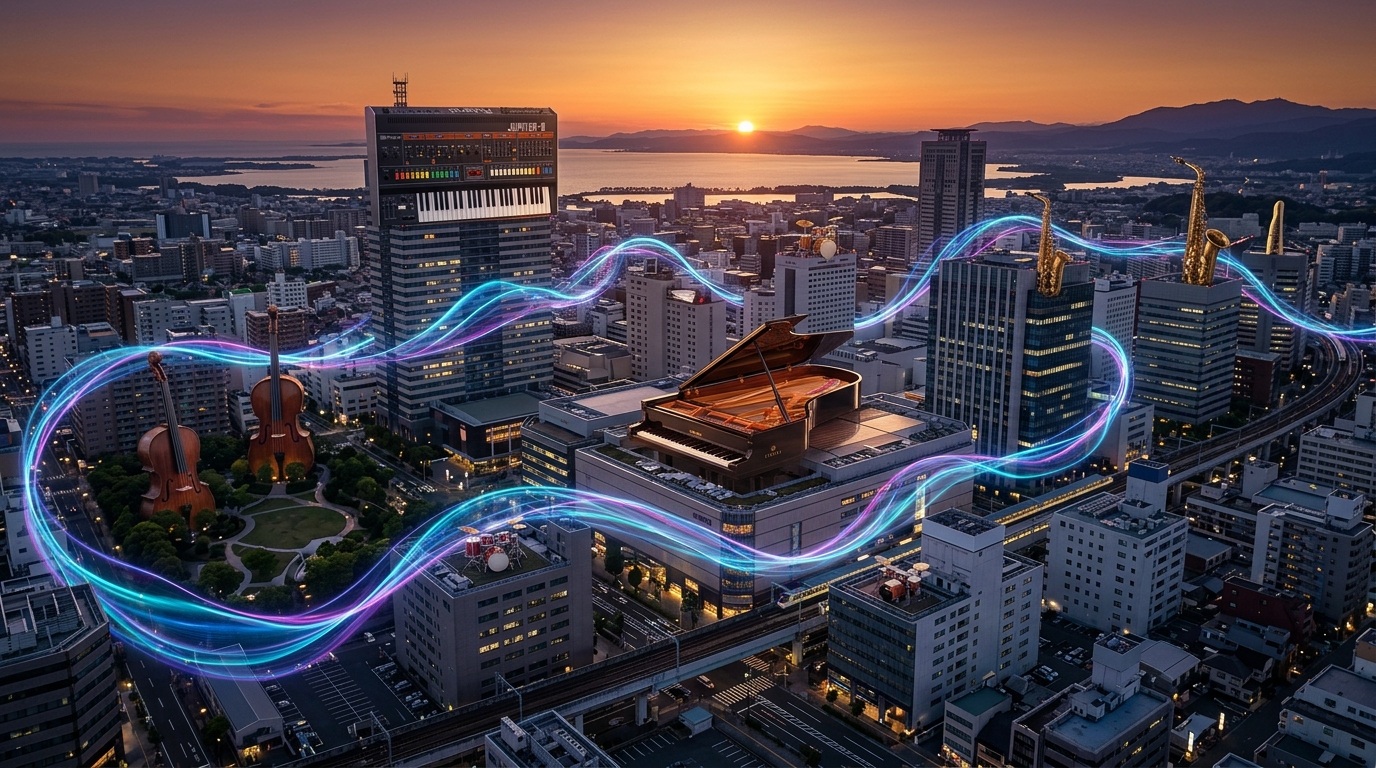
- Introduction: The Unknown City That Changed Global Music
- The Shizuoka–Hamamatsu Creative Industrial Cluster (Visual Guide)
- Where Is Hamamatsu and Why Does It Matter?
- The Birth of Japan’s Instrument Industry
- Yamaha: From Pianos to Global Sound Powerhouse
- Roland: The Revolution of Electronic Music
- Korg: Innovation and the Future of Sound
- Why Hamamatsu Became a Global Music Cluster
- Why Hamamatsu Became the Global Capital of Sound (Deeper Insight)
- The 1980s Synthesizer Revolution
- Japanese Manufacturing Philosophy and Sound Precision
- Why Japan Succeeded Where Others Didn’t
- How Japan Democratized Music Creation
- How to Start Exploring Japanese Sound Culture
- Global Impact: From Hamamatsu to the World
- Beyond Music: Why Hamamatsu and Shizuoka Became a Global Hub for Passion Industries
- A Hidden Location on Japan’s Golden Route
- How to Reach Hamamatsu: Tokyo vs Osaka
- What to Actually Experience in Hamamatsu (Travel Guide)
- Explore More Japanese Culture and Innovation
- Why You Should Visit Hamamatsu Now
- Conclusion: The City Behind Modern Sound
- FAQ: Japanese Music Culture and Hamamatsu
- Related Articles
Introduction: The Unknown City That Changed Global Music
Before Spotify, before digital streaming, before bedroom producers created hits on laptops, modern music was shaped by something far less visible: a city.
That city is Hamamatsu.
Located in Shizuoka Prefecture, Japan, Hamamatsu is not widely known outside the country. It is not Tokyo. It is not Osaka. It is not even a major tourist destination.
And yet, this single city helped shape how the entire world creates, produces, and experiences music.
Hamamatsu is home to some of the most influential musical instrument companies in history:
• Yamaha
• Roland
• Kawai
• Suzuki Musical Instruments
From traditional pianos to cutting-edge synthesizers, these companies did more than manufacture instruments.
They transformed music itself.
This is the story of how a relatively unknown Japanese city became the global capital of sound.
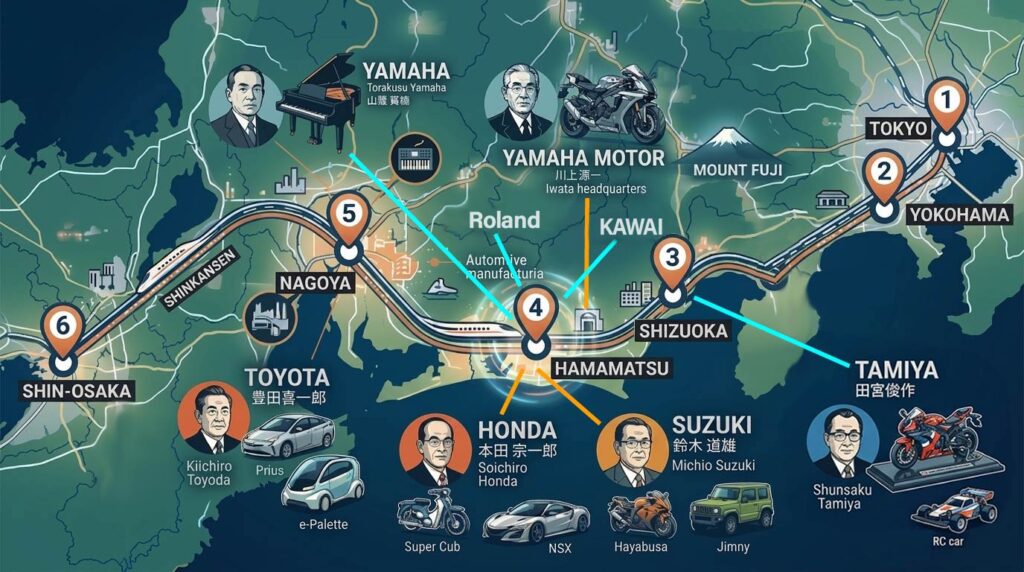
The Shizuoka–Hamamatsu Creative Industrial Cluster (Visual Guide)
What you are looking at is not just a map.
It is one of the most unique industrial and cultural clusters in the world.
Within a relatively small corridor between Tokyo and Osaka, Japan has concentrated multiple globally dominant industries:
• Musical instruments (Yamaha, Roland, Korg)
• Motorcycles (Honda, Yamaha, Suzuki)
• Automobiles (Toyota Group origins)
• Hobby industries (Tamiya and model culture)
What makes this region extraordinary is not just the presence of these companies — but their proximity.
Ideas, engineering knowledge, and craftsmanship have historically flowed across industries.
For example:
• Loom technology influenced automobile manufacturing
• Precision engineering influenced musical instruments
• Manufacturing philosophy shaped global product design
This is not a coincidence.
It is a regional ecosystem.
Today, this area remains one of the most important creative-industrial zones in the world.
And yet, it is still largely unknown to international travelers.
This is why Hamamatsu and Shizuoka are not just destinations.
They are origins of global culture.
What It Feels Like to Stand in Hamamatsu
Reading about Hamamatsu is one thing.
Standing there is something completely different.
The city does not feel like a typical tourist destination.
There are no overwhelming crowds, no flashy attractions dominating the skyline.
Instead, there is a quiet sense of purpose.
You notice it in small details:
• The sound of instruments being tested in local shops
• The presence of factories that quietly shaped global culture
• The balance between everyday life and world-class manufacturing
Hamamatsu feels like a place where things are made — not just products, but culture itself.
When you realize that some of the most influential sounds in history were born here, the city begins to feel different.
Less like a destination.
More like an origin point.
Where Is Hamamatsu and Why Does It Matter?
Hamamatsu sits between Tokyo and Nagoya, facing the Pacific Ocean. At first glance, it appears to be just another industrial city.
But beneath the surface lies something unique.
Unlike most regions in the world, Hamamatsu developed as a concentrated hub of musical instrument manufacturing.
This clustering effect created an environment where:
• Engineers collaborated across companies
• Innovation accelerated
• Competition drove quality
This kind of ecosystem is rare.
In most countries, instrument makers are scattered. In Hamamatsu, they are neighbors.
That proximity changed everything.
The Birth of Japan’s Instrument Industry
The story begins in the late 19th century.
Torakusu Yamaha, a watch repairman, was asked to fix a broken reed organ in a local school.
Instead of simply repairing it, he built a new one.
That moment marked the beginning of Japan’s modern instrument industry.
Soon after:
• Yamaha began producing pianos
• Local craftsmanship expanded
• Skills spread throughout the region
Hamamatsu became a center of instrument-making expertise.
This was not accidental.
It was the result of craftsmanship, curiosity, and a culture of continuous improvement.
Yamaha: From Pianos to Global Sound Powerhouse

Yamaha started with pianos but did not stop there.
Over time, it expanded into:
• Electronic instruments
• Synthesizers
• Audio equipment
One of its most important contributions was the DX7 synthesizer, released in 1983.
This instrument:
• Was affordable
• Used digital FM synthesis
• Became a global standard
The DX7 defined the sound of the 1980s.
From pop to film scores, its influence is everywhere.
Yamaha didn’t just build instruments.
It built the sound of an era.
Roland: The Revolution of Electronic Music
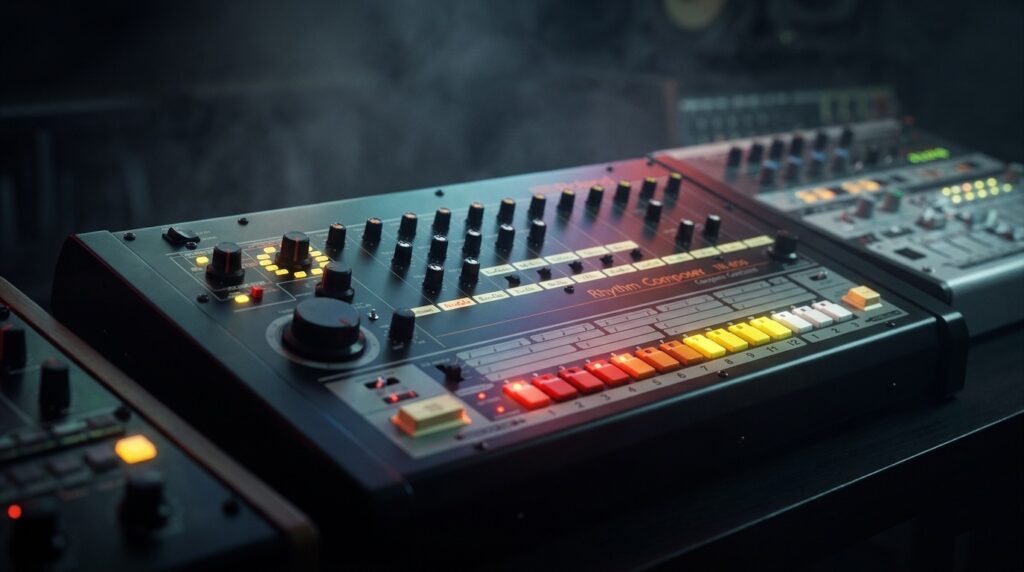
If Yamaha shaped digital sound, Roland shaped rhythm.
Founded in Osaka but deeply connected to Japan’s instrument ecosystem, Roland introduced machines that changed music forever:
• TR-808
• TR-909
• TB-303
These weren’t just tools.
They created entirely new genres:
• Hip-hop
• Techno
• House
The TR-808 alone became one of the most iconic sounds in history.
Even today, its sound is used in global hits.
Roland didn’t follow music trends.
It created them.
BOSS: The Legendary Sound Behind Rock, Metal, and Guitar Culture
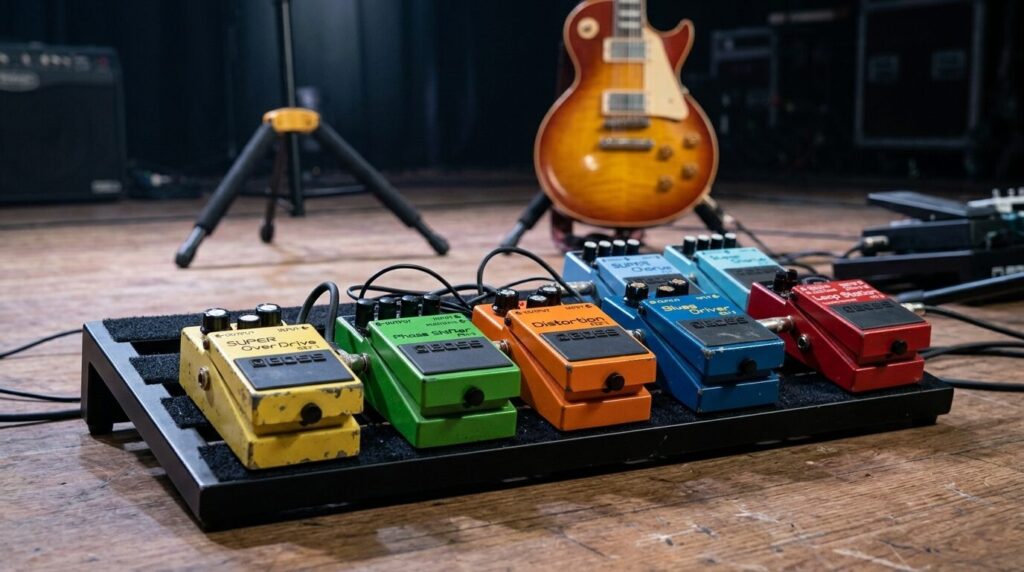
One more thing many rock and guitar fans don’t realize:
The legendary guitar effects and amplifier brand BOSS is also part of Roland.
From compact pedals to stage-ready gear, BOSS has shaped the sound of rock, metal, and blues for decades.
For many riders and guitar players around the world, BOSS isn’t just a brand — it’s part of their identity.
And yes — it comes from the same region as Yamaha and Hamamatsu.
Rock, Motorcycles, and Rebellion: A Shared Culture
Rock music and motorcycles have always shared the same spirit.
From the 1970s to the 1990s, rock musicians didn’t just create music — they defined a lifestyle.
Leather jackets, loud engines, and distorted guitars became symbols of freedom.
Icons of rock were often seen riding motorcycles, embracing speed, independence, and rebellion.
This connection is not accidental.
Both rock music and motorcycles represent:
• Freedom
• Individual expression
• Breaking away from the ordinary
The same era that gave us legendary guitar sounds also produced some of the most iconic motorcycles in the world — many of them from Japan.
Yamaha, for example, didn’t just build instruments.
It built motorcycles that carried the same philosophy:
Performance, emotion, and identity.
For many people, the connection is still alive today.
A rider with a guitar.
A musician with a machine.
Different tools — same spirit.
Korg: Innovation and the Future of Sound
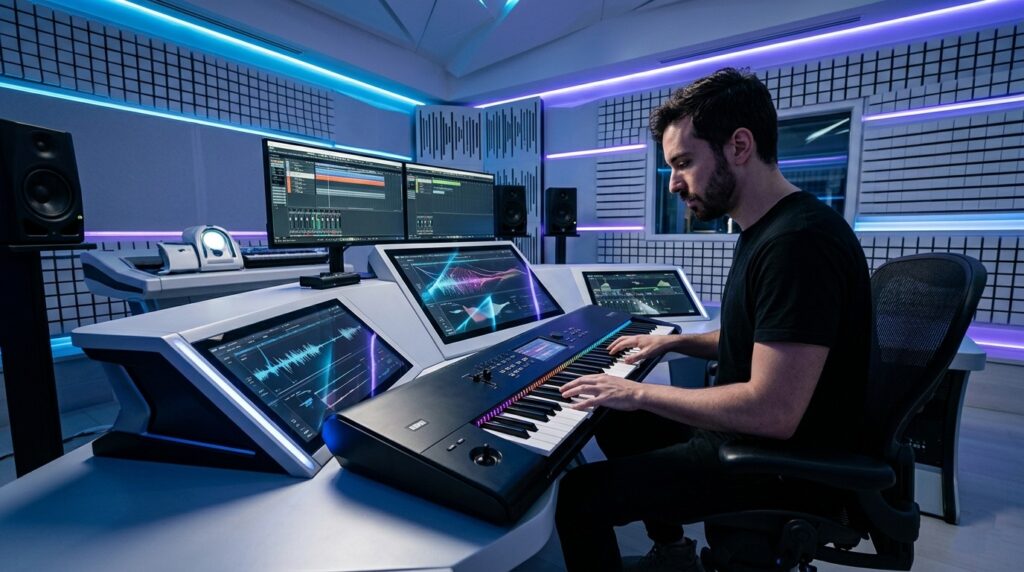
Korg took a different path.
It focused on:
• User-friendly design
• Experimental sound
• Digital workstations
Korg instruments helped bring music production to a wider audience.
They were accessible, intuitive, and powerful.
This made them popular among both professionals and beginners.
Korg represents the spirit of innovation that defines Japan’s music industry.
Why Hamamatsu Became a Global Music Cluster
This is the most important question:
Why Hamamatsu?
Several factors combined:
1. Skilled Craftsmanship
Japan has a long tradition of precision craftsmanship.
2. Industrial Collaboration
Companies shared knowledge indirectly through proximity.
3. Competition
Multiple companies in one region pushed each other to innovate.
4. Manufacturing Culture
Continuous improvement (Kaizen) ensured high quality.
Why Did This Happen in Japan?
This concentration of innovation did not happen by accident.
Japan developed a unique approach to manufacturing and creativity.
Unlike many Western industries that separated engineering, design, and culture, Japan often merged them.
In regions like Hamamatsu, engineers, musicians, and craftsmen operated within close proximity.
This created:
• Faster innovation cycles
• Cross-industry inspiration
• A deep connection between product and user experience
At the same time, Japanese companies focused on making high-quality tools more accessible.
Instead of limiting technology to professionals, they enabled individuals to create.
This is what changed music globally.
Not just better instruments.
But more people making music.
Why Hamamatsu Became the Global Capital of Sound (Deeper Insight)
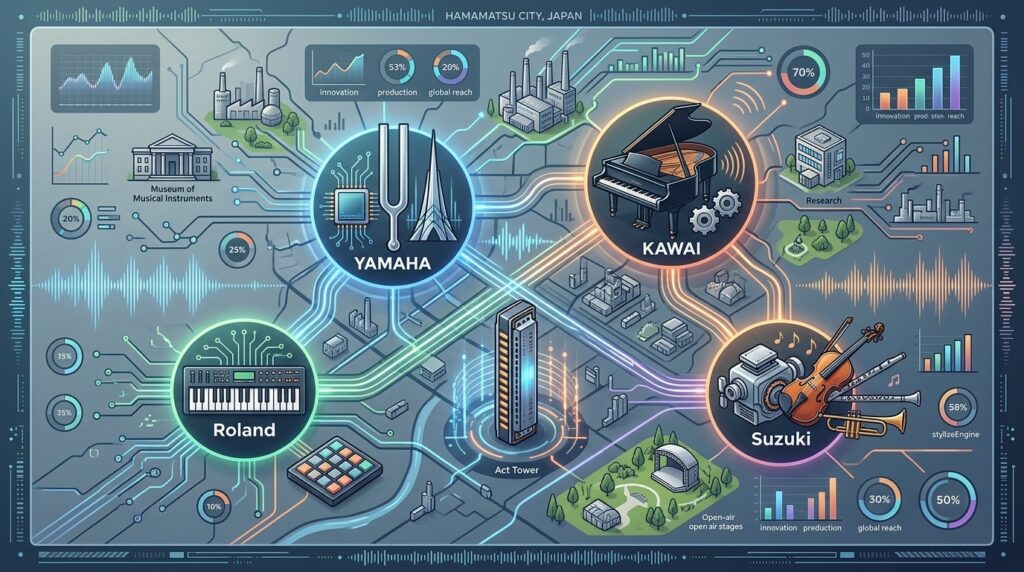
At first glance, it may seem like a coincidence that so many influential music companies emerged from Hamamatsu.
But it wasn’t luck.
It was structure.
Hamamatsu developed a rare industrial ecosystem where craftsmanship, engineering, and creativity existed in the same place at the same time.
For example, instrument makers, parts manufacturers, and skilled technicians were all located within the same region. This meant that ideas could move faster than in countries where industries were geographically separated.
A piano builder could influence an electronic engineer. A mechanical technician could contribute to sound design.
This kind of cross-industry interaction is extremely rare.
In addition, Hamamatsu’s proximity to Tokyo and Nagoya allowed companies to access both talent and distribution networks, while still maintaining a strong local manufacturing identity.
This combination of:
• Local craftsmanship
• Industrial density
• Cultural curiosity
created the perfect environment for innovation.
This is why Hamamatsu didn’t just produce instruments.
It produced an entire culture of sound.
The 1980s Synthesizer Revolution
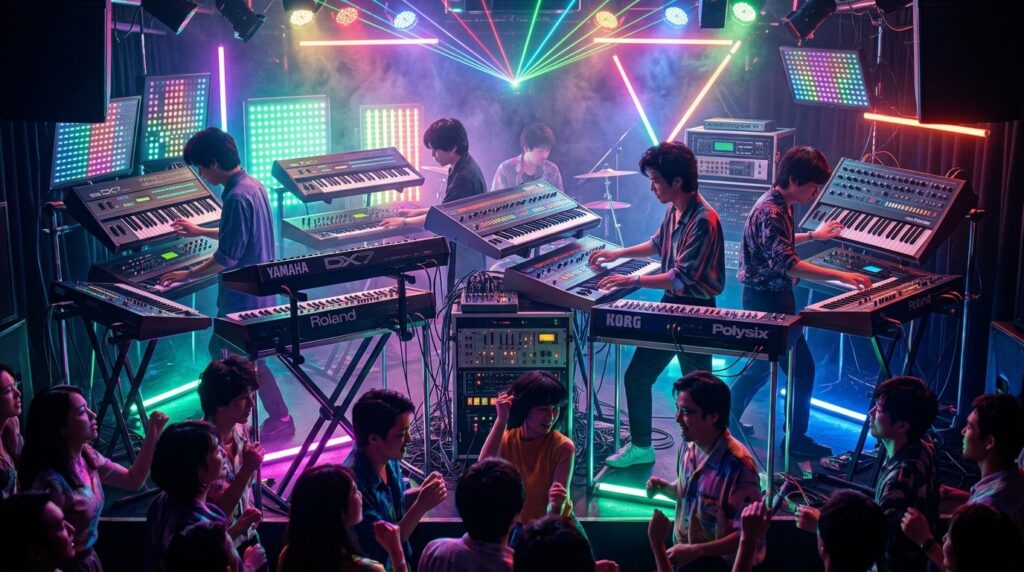
The 1980s changed everything.
Before this era:
• Music production was expensive
• Instruments were large and complex
Japan changed that.
Companies in and around Hamamatsu created:
• Affordable synthesizers
• Compact drum machines
• Portable instruments
This made music accessible.
For the first time:
👉 Individuals could create music at home
This was the beginning of modern music production.
Japanese Manufacturing Philosophy and Sound Precision
Japanese manufacturing is not just about efficiency.
It is about philosophy.
Key principles include:
• Precision
• Reliability
• Continuous improvement
This mindset influenced instrument design.
Musicians trusted Japanese instruments because:
• They were consistent
• They were durable
• They sounded excellent
This trust helped Japan dominate the global market.
Why Japan Succeeded Where Others Didn’t
Many countries had access to technology.
But only Japan combined technology with cultural discipline.
In Western countries, music companies and electronics companies often developed separately.
In Japan, they evolved together.
For example:
• Yamaha combined instrument craftsmanship with electronics
• Sony connected audio devices with lifestyle
• Roland focused on usability and creativity
This integration allowed Japan to move faster.
Another key factor was mindset.
Japanese engineers focused not only on innovation, but also on refinement.
Instead of asking:
“What can we invent?”
They asked:
“How can we make this better for the user?”
This user-first philosophy is why Japanese instruments became trusted worldwide.
And trust is what builds global standards.
How Japan Democratized Music Creation
Before Japan’s influence:
👉 Music = professional studios
After:
👉 Music = anyone, anywhere
This shift changed everything.
It led to:
• Independent artists
• New genres
• Global music diversity
Modern DAWs and home studios all trace back to this revolution.
How to Start Exploring Japanese Sound Culture
You don’t need to be a professional musician to experience the impact of Japanese sound innovation.
Here are simple ways to start:
1. Try a Beginner Synthesizer
Brands like Yamaha, Roland, and Korg offer entry-level synthesizers that are easy to use and affordable.
2. Explore Digital Music Tools
Modern DAWs (Digital Audio Workstations) are inspired by the same philosophy that began in 1980s Japan: making music accessible to everyone.
3. Listen to City Pop
Start with artists like Tatsuro Yamashita or Mariya Takeuchi to understand how Japanese sound aesthetics influenced global music.
4. Read Related Guides
To go deeper, explore:
→ Japanese Synthesizer Culture (coming soon)
→ DTM Culture in Japan (coming soon)
→ City Pop Music Guide (coming soon)
5. Visit Japan
The ultimate experience is to visit Hamamatsu and see where it all began.
This journey connects technology, culture, and music in a way no online experience can fully replicate.
Global Impact: From Hamamatsu to the World
Hamamatsu’s influence spread worldwide.
American hip-hop used Roland machines.
European techno relied on Japanese synths.
Pop music adopted Yamaha keyboards.
Today:
👉 Global music is built on Japanese innovation
Beyond Music: Why Hamamatsu and Shizuoka Became a Global Hub for Passion Industries
Hamamatsu is not only the birthplace of global music innovation.
It is part of something much bigger.
This region — including Hamamatsu and the wider Shizuoka area — has produced multiple world-leading industries that shape how people experience passion, creativity, and lifestyle.
The Motorcycle Revolution from Hamamatsu
Few people realize that Hamamatsu is also one of the most important cities in the history of motorcycles.
It is home to global manufacturers such as:
• Honda (early development roots)
• Yamaha Motor
• Suzuki
These companies did not just build transportation.
They created a global motorcycle culture.
From racing circuits to touring lifestyles, Japanese motorcycles redefined:
• Performance
• Reliability
• Accessibility
Today, Japanese brands dominate the global motorcycle market.
👉 Explore more:
→ Why Japan Dominated Motorcycles
https://www.hamagolden.tokyo/en/why-japan-dominated-motorcycles/
→ Why Japan Became the Motorcycle Capital of the World
https://www.hamagolden.tokyo/en/why-japan-became-the-motorcycle-capital-of-the-world/
→ Why Hamamatsu Is the Heart of Motorcycle Culture
https://www.hamagolden.tokyo/en/why-hamamatsu-is-the-heart-of-motorcycle-culture/
From Looms to Engines: The Industrial DNA of Innovation
The origins of this industrial power go even deeper.
Before motorcycles and instruments, this region was built on textile machinery.
One key figure was Sakichi Toyoda, founder of Toyota Industries in 1926.
His invention of automatic looms revolutionized manufacturing and laid the foundation for the Toyota Group.
This philosophy of:
• Precision
• Automation
• Continuous improvement
spread across nearby regions.
Suzuki, for example, began as a loom manufacturer (Suzuki Loom Works) before evolving into a global motorcycle and automobile company.
This pattern is not a coincidence.
It shows how a single regional mindset can evolve across industries.
A Rare Global Phenomenon
What makes this region truly unique is concentration.
In most parts of the world:
• Music industry → one region
• Automotive industry → another
• Hobby culture → separate
But in Hamamatsu and Shizuoka, these industries coexist.
Within a relatively small geographic area, you will find:
• Global musical instrument manufacturers
• World-leading motorcycle companies
• Precision model and hobby industries
This creates a rare ecosystem where:
👉 Engineering meets creativity
👉 Industry meets culture
👉 Function meets passion
Not the Past — The Present
This is not history.
These companies still lead the world today.
Yamaha, Roland, Suzuki, and others continue to innovate and influence global markets.
Hamamatsu is not a “former industrial city.”
It is an active global hub.
Why This Matters for Visitors
For travelers, this changes everything.
Visiting Hamamatsu is not just sightseeing.
It is experiencing the origin of multiple global cultures:
• Music
• Motorcycles
• Craftsmanship
Few places in the world offer this depth.
If you are interested in how passion becomes global culture, this region is one of the most important destinations you can visit.
Why Musicians Should Visit Hamamatsu
Hamamatsu is not just history.
It is a living cultural destination.
For music lovers, it is a pilgrimage site.
A Hidden Location on Japan’s Golden Route
For many international travelers, Japan is often imagined as a simple route:
Tokyo → Kyoto → Osaka
Along the way, there is one iconic symbol everyone recognizes:
Mount Fuji.
But what most people don’t realize is this:
👉 One of the most important cultural and industrial regions in the world sits directly on this same route.
Hamamatsu.
Located between Tokyo and Osaka, Hamamatsu is not remote at all.
In fact, it lies on the Tokaido Shinkansen line, Japan’s main high-speed corridor connecting the country’s largest cities.
This means:
• You pass near Hamamatsu when traveling across Japan
• You can stop without changing your main route
• You are already close — you just didn’t know it
For many visitors, discovering Hamamatsu feels like finding something hidden in plain sight.
You came for Tokyo, Kyoto, and Mount Fuji.
But you were actually traveling through the birthplace of modern music, motorcycles, and global craftsmanship.
This changes how you see Japan.
And it may change where you decide to go next.
How to Reach Hamamatsu: Tokyo vs Osaka
| Route | Transport | Time | Cost (Approx) |
|---|---|---|---|
| Tokyo → Hamamatsu | Shinkansen | ~1.5 hours | ~$90 (¥13,000) |
| Tokyo → Hamamatsu | Car / Motorcycle | ~3.5–4 hours | ~$50–70 (tolls) |
| Osaka → Hamamatsu | Shinkansen | ~1.5 hours | ~$90 (¥13,000) |
| Osaka → Hamamatsu | Car / Motorcycle | ~3–4 hours | ~$50–70 (tolls) |
Why This Matters
Hamamatsu is not remote.
It is directly connected to Japan’s main economic corridor.
This means you can:
• Visit from Tokyo in a day
• Travel from Osaka easily
• Explore the entire region efficiently
For international visitors, this accessibility makes Hamamatsu a realistic and highly valuable destination.
What to Actually Experience in Hamamatsu (Travel Guide)
If you visit Hamamatsu, you are not just visiting a city.
You are stepping into the origin of modern sound.
Here are real places you can experience:
Yamaha Innovation Road
A free museum where you can explore the history of Yamaha instruments, from pianos to advanced synthesizers.
Hamamatsu Museum of Musical Instruments
One of the largest collections of instruments in the world, including rare global instruments and Japanese innovations.
Local Instrument Factories
Some workshops and factories offer tours where you can see how instruments are built with precision.
Nearby Shizuoka Hobby Culture
Hamamatsu is also connected to a broader cultural zone.
If you are interested in Japanese craftsmanship, you should also explore:
→ Tamiya (model culture)
→ Mini 4WD racing culture
→ Gunpla (Gundam plastic models)
These industries share the same DNA: precision, passion, and creativity.
This makes the entire Shizuoka region one of the most unique cultural clusters in the world.
Visiting Hamamatsu is not just tourism.
It is a cultural experience.
Explore More Japanese Culture and Innovation
If you are interested in how Japan creates globally influential culture, you may also enjoy:
• Tamiya Model Culture (precision hobby industry)
• Mini 4WD Racing in Japan
• Gunpla and Japanese Plastic Model Culture
• Shizuoka Travel Guide: Japan’s Hidden Creative Region
These fields may seem different from music.
But they share the same foundation:
• Craftsmanship
• Innovation
• Passion for detail
Together, they form a unique ecosystem that continues to influence the world.
Why You Should Visit Hamamatsu Now
There are many places in the world where you can listen to music.
There are far fewer places where you can understand where that music came from.
Hamamatsu is one of them.
If you are interested in:
• Music
• Motorcycles
• Craftsmanship
• Creative culture
then this city offers something unique.
It connects ideas that are usually separated.
And once you see that connection, it becomes difficult to unsee.
You may arrive out of curiosity.
But you will leave with a different understanding of how culture is created.
And that makes Hamamatsu more than a destination.
It makes it a place worth experiencing.
Conclusion: The City Behind Modern Sound
Hamamatsu is more than a city.
It is the foundation of modern music.
From pianos to synthesizers, from analog to digital, from studios to bedrooms—
Hamamatsu helped shape it all.
Most people have never heard of it.
But everyone has heard its sound.
FAQ: Japanese Music Culture and Hamamatsu
1. Why is Hamamatsu important in global music history?
Hamamatsu is home to major musical instrument companies such as Yamaha, Roland, Kawai, and Suzuki. These companies developed technologies that shaped modern music production, including synthesizers and electronic instruments used worldwide.
2. Are Yamaha and Roland really from the same city?
Yes. Both Yamaha and Roland have strong roots in Hamamatsu, Japan. This rare concentration of global music companies in one region is one of the reasons Hamamatsu became a center of innovation.
3. Why did Japan dominate synthesizers in the 1980s?
Japanese companies focused on making synthesizers more affordable, compact, and user-friendly. This allowed more musicians to create music, leading to the global spread of electronic music.
4. How did Sony and the Walkman change music culture?
The Sony Walkman made music portable and personal for the first time. It changed how people listened to music and influenced how artists produced sound, especially for headphone listening.
5. Is Hamamatsu worth visiting for music fans?
Yes. Hamamatsu offers a unique experience where you can explore the origins of global music culture, visit instrument-related locations, and understand how modern sound was created.