- Introduction
- Why Japanese Motorcycles Matter Globally
- The Birth of Japanese Motorcycles (1900s–1945)
- Post-War Motorcycle Boom (1945–1960)
- The Big Four Rise (1960s–1970s)
- The Japanese Motorcycle Revolution (1970s–1980s)
- Technology Leadership Era (1980s–1990s)
- Legendary Japanese Motorcycles That Changed History
- Global Domination (1990s–2000s)
- Modern Japanese Motorcycles (2000–Present)
- Japanese Motorcycle Culture and Touring
- Why Japanese Motorcycles Are Known for Reliability
- Japanese Motorcycle Brands Comparison: The Big Four Explained
- Why Japanese Motorcycles Became the World’s Best
- The Future of Japanese Motorcycles
- Japanese Motorcycles vs European Motorcycles
- Conclusion
- RELATED ARTICLES
Introduction
Japanese motorcycles are among the most respected machines in the world. From small commuter bikes to high-performance superbikes, Japanese manufacturers have shaped the global motorcycle industry for decades.
Today, brands like Honda, Yamaha, Suzuki, and Kawasaki dominate global markets. Their motorcycles are known for reliability, performance, and innovation. But this success did not happen overnight.
The history of Japanese motorcycles is a story of resilience, engineering brilliance, and cultural transformation. From post-war survival to global leadership, Japanese manufacturers built a motorcycle empire that changed transportation worldwide.
This guide explores the complete history of Japanese motorcycles — from their earliest origins to modern-day innovation.
Why Japanese Motorcycles Matter Globally
Japanese motorcycles transformed transportation worldwide.
They helped:
- Make motorcycles affordable
- Improve reliability
- Expand global motorcycle culture
Today, Japanese motorcycles are used in:
- Commuting
- Touring
- Racing
- Adventure riding
This global impact makes Japanese motorcycles one of the most important innovations in transportation history.
The Birth of Japanese Motorcycles (1900s–1945)
Early Motorcycle Experiments in Japan
Japan’s motorcycle journey began in the early 1900s. During this period, motorcycles were imported mainly from Europe and the United States.
Brands like Harley-Davidson and Indian dominated the early Japanese motorcycle scene.
Japanese engineers began experimenting with domestic motorcycle production in the 1920s and 1930s.
Some early manufacturers included:
- Meguro
- Rikuo
- Miyata
These early motorcycles were often copies of Western designs.
Rikuo and Harley-Davidson Influence
One interesting example was Rikuo motorcycles. These were heavily based on Harley-Davidson designs and were even licensed by Harley-Davidson in Japan.
Rikuo motorcycles were mainly used by:
- Military
- Police
- Government officials
This period laid the foundation for Japan’s future motorcycle industry.
Post-War Motorcycle Boom (1945–1960)
Watch: The Birth of Japanese Motorcycles
Before Japanese motorcycles became global icons, they started from something much simpler.
In the post-war period, small engines were attached to bicycles to create affordable transportation.
This short video captures the atmosphere of that era—the raw beginnings of what would later become one of the most advanced motorcycle industries in the world.
What you are seeing is not just a machine.
It is the origin of a culture built on necessity, creativity, and relentless improvement.
Japan After World War II
After World War II, Japan faced economic devastation. Transportation was limited, and people needed affordable mobility.
Motorcycles became the perfect solution.
Small engine motorcycles became extremely popular because they were:
- Cheap
- Fuel-efficient
- Easy to maintain
This created massive demand.
Honda’s Beginning
Honda Motor Company was founded in 1948 by Soichiro Honda.
Honda started by attaching small engines to bicycles.
The Honda Dream became one of the earliest successful motorcycles.
Soon, Honda became Japan’s largest motorcycle manufacturer.
Yamaha Joins the Market
Yamaha entered the motorcycle market in 1955.
Their first motorcycle:
Yamaha YA-1
Nicknamed “Red Dragonfly”
Yamaha quickly gained attention by winning racing competitions.
Suzuki and Kawasaki Enter
Suzuki began motorcycle production in 1952.
Kawasaki entered the motorcycle market later, in the 1960s, after acquiring Meguro.
The Big Four Rise (1960s–1970s)
The Japanese Big Four emerged:
- Honda
- Yamaha
- Suzuki
- Kawasaki
These brands began competing aggressively.
Honda Super Cub Revolution
Honda launched the Super Cub in 1958.
It became:
- The best-selling motorcycle in history
- Over 100 million units sold
This changed global transportation forever.
Japanese Manufacturers Go Global
Japanese motorcycles began entering:
- United States
- Europe
- Southeast Asia
Their advantages:
- Affordable price
- High reliability
- Easy maintenance
The Japanese Motorcycle Revolution (1970s–1980s)
Honda CB750 – The First Superbike
In 1969, Honda launched the CB750.
Features included:
- Inline four engine
- Disc brakes
- Electric starter
This motorcycle changed everything.
It became known as the first modern superbike.
Kawasaki Z1
Kawasaki launched the Z1 in 1972.
It became one of the fastest motorcycles of its time.
Yamaha Performance Era
Yamaha focused on performance bikes.
Popular models:
- Yamaha RD350
- Yamaha XS650
Yamaha built a reputation for sporty motorcycles.
Suzuki Two-Stroke Dominance
Suzuki became famous for:
- Lightweight bikes
- Racing performance
Technology Leadership Era (1980s–1990s)
Japanese manufacturers dominated technology.
Rise of Sport Bikes
Legendary bikes included:
- Honda CBR900RR
- Yamaha FZR1000
- Suzuki GSX-R750
- Kawasaki Ninja
These bikes introduced:
- Lightweight frames
- Aerodynamics
- High performance engines
Racing Dominance
Japanese manufacturers dominated:
- MotoGP
- Superbike racing
Racing improved production motorcycles.
Legendary Japanese Motorcycles That Changed History
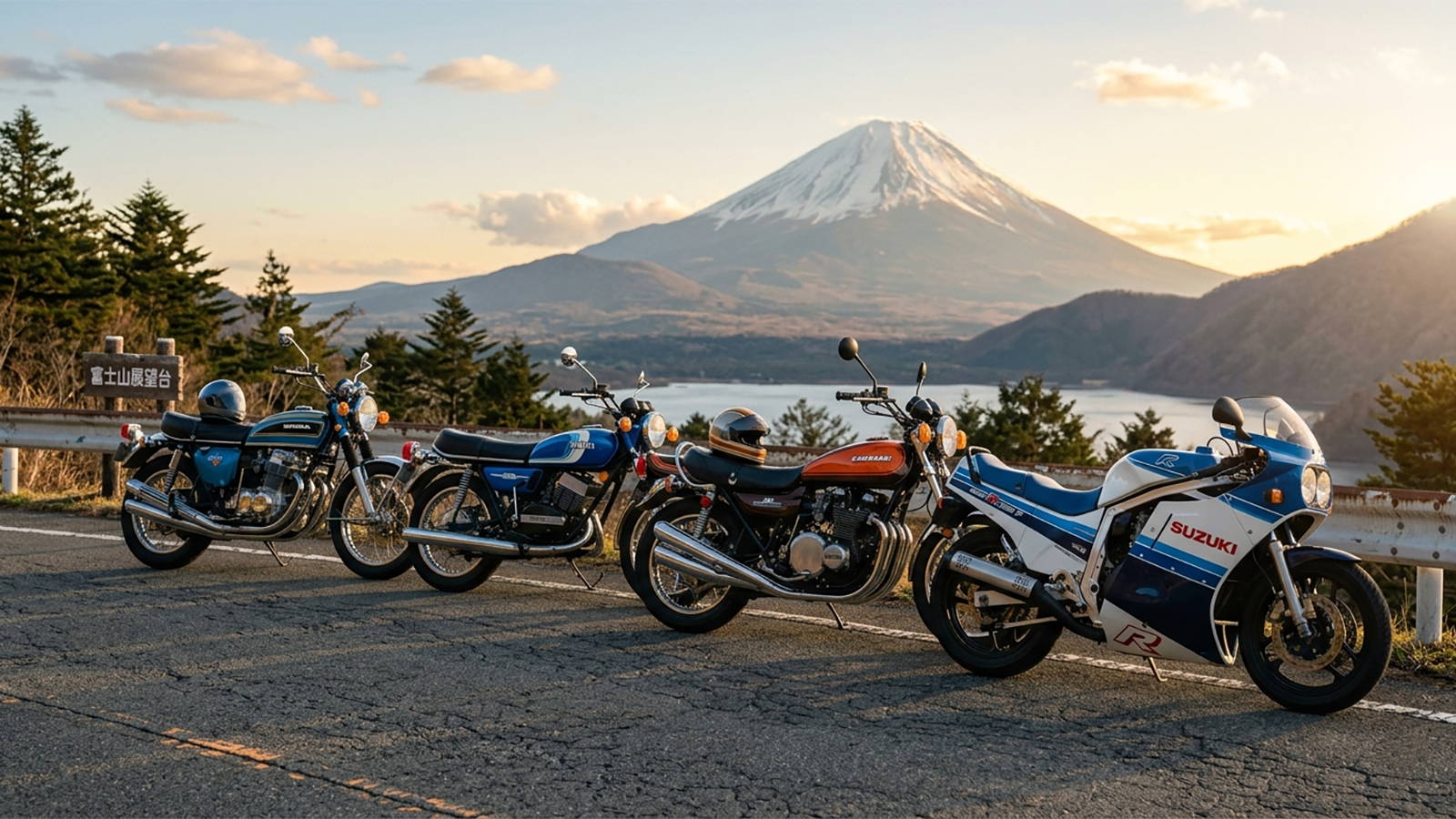
Over the decades, several Japanese motorcycles changed the global industry forever.
These models defined performance, reliability, and innovation.
1960s
- Honda Super Cub
- Yamaha YA-1
1970s
- Honda CB750
- Kawasaki Z1
- Yamaha RD350
1980s
- Suzuki GSX-R750
- Honda CBR900RR
- Kawasaki Ninja GPZ900R
1990s
- Honda Fireblade
- Yamaha R1
- Suzuki Hayabusa
2000s and Beyond
- Kawasaki Ninja H2
- Yamaha MT Series
- Honda Africa Twin
These motorcycles shaped modern motorcycling.
Global Domination (1990s–2000s)
Japanese motorcycles became global leaders.
Reliability Reputation
Japanese motorcycles became known for:
- Reliability
- Affordable maintenance
- Long lifespan
Touring Motorcycles
Popular touring bikes:
- Honda Gold Wing
- Yamaha FJR1300
- Kawasaki Concours
These bikes became favorites for long-distance touring.
Modern Japanese Motorcycles (2000–Present)
Modern Japanese motorcycles include:
- Adventure bikes
- Naked bikes
- Touring bikes
- Electric motorcycles
Popular modern bikes:
- Yamaha MT-07
- Honda Africa Twin
- Kawasaki Ninja H2
- Suzuki Hayabusa
Japanese Motorcycle Culture and Touring
Japan offers incredible riding routes:
- Hakone Turnpike
- Mount Fuji Roads
- Hokkaido Touring
- Shikoku Routes
Japanese riders value:
- Respect
- Safety
- Scenic riding
Why Japanese Motorcycles Are Known for Reliability
Japanese motorcycles earned their reputation for reliability through decades of engineering discipline.
Key reasons include:
Manufacturing Precision
Japanese manufacturers focus heavily on precision manufacturing.
Factories maintain strict quality control standards.
Engineering Philosophy
Japanese engineers prioritize:
- Durability
- Efficiency
- Ease of maintenance
Continuous Improvement
Japanese companies follow a philosophy called “Kaizen,” meaning continuous improvement.
This mindset helped Japanese motorcycles become more reliable over time.
Japanese Motorcycle Brands Comparison: The Big Four Explained
The Japanese motorcycle industry is dominated by four major manufacturers known as the “Big Four.” Each brand has developed a unique identity and riding philosophy over decades.
Understanding these differences helps riders choose the best motorcycle for their needs.
Honda – Reliability and Innovation
Honda is the world’s largest motorcycle manufacturer. The brand focuses on reliability, ease of use, and innovation.
Popular Honda motorcycles include:
- Honda Super Cub
- Honda CB750
- Honda Africa Twin
- Honda Gold Wing
Honda motorcycles are known for:
- Smooth engines
- Comfortable riding
- Long-term reliability
Honda is often recommended for beginners and touring riders.
Yamaha – Performance and Style
Yamaha motorcycles are known for sporty performance and aggressive styling.
Popular Yamaha motorcycles include:
- Yamaha R1
- Yamaha MT-07
- Yamaha Tenere 700
- Yamaha XSR900
Yamaha focuses on:
- Performance
- Lightweight design
- Rider excitement
Yamaha motorcycles are popular among sport riders and enthusiasts.
Kawasaki – Power and Speed
Kawasaki is famous for powerful engines and high-speed motorcycles.
Popular Kawasaki motorcycles include:
- Kawasaki Ninja series
- Kawasaki Z series
- Kawasaki H2
Kawasaki motorcycles are known for:
- Strong acceleration
- Aggressive styling
- High performance
Kawasaki is popular among experienced riders.
Suzuki – Value and Balance
Suzuki focuses on performance and affordability.
Popular Suzuki motorcycles include:
- Suzuki Hayabusa
- Suzuki GSX-R series
- Suzuki V-Strom
Suzuki motorcycles offer:
- Great performance
- Competitive pricing
- Balanced riding experience
Suzuki is often considered the best value among the Big Four.
Why Japanese Motorcycles Became the World’s Best
Reasons include:
- Engineering excellence
- Reliability
- Innovation
- Affordable pricing
The Future of Japanese Motorcycles
Future trends:
- Electric motorcycles
- Hybrid engines
- Smart technology
Japanese Motorcycles vs European Motorcycles
Japanese and European motorcycles offer different riding experiences.
Japanese Motorcycles
- Reliable
- Affordable
- Easy to maintain
- Comfortable
European Motorcycles
- Premium design
- Advanced electronics
- High price
- Strong brand identity
Both offer excellent performance, but Japanese motorcycles are often more practical.
Conclusion
Japanese motorcycles transformed global transportation. From humble beginnings to world dominance, Japan’s motorcycle industry remains one of the most influential forces in motorcycling.
Their legacy continues today — and the next chapter is already being written.
RELATED ARTICLES
- Best Japanese Motorcycles Ever Made
- Honda Motorcycle History
- Yamaha Motorcycle Evolution
- Kawasaki Ninja History
- Suzuki Sport Bike History
- Japanese Motorcycle Touring Guide
- Best Roads in Japan for Motorcycles
- Japanese Motorcycle Culture
- Classic Japanese Motorcycles
- Japanese Motorcycle Buying Guide