- Introduction
- The Japanese Motorcycle Miracle (1980–1999)
- The Power of Japanese Manufacturing Culture
- Kaizen and Just-in-Time: Japan’s Manufacturing Advantage
- Japan’s Hidden Supplier Network
- Electronics: Japan’s Secret Weapon
- Precision Manufacturing and Machine Tools
- The Power of Domestic Competition
- The Japanese Supply Chain Advantage
- Japanese Motorcycle Industry Clusters
- Why This Could Only Happen in Japan
- The Legacy of Japanese Engineering
- Japan as a Motorcycle Pilgrimage Destination
- Conclusion
- RELATED ARTICLES
Introduction
In the 1980s and 1990s, Japanese motorcycles dominated the world. Honda, Yamaha, Suzuki, and Kawasaki produced machines that were faster, more reliable, and more affordable than their European and American competitors.
But the real story goes deeper.
Japan’s success was not just about motorcycle manufacturers. It was about something much bigger — an entire ecosystem of engineering excellence.
Within a relatively small country, Japan built one of the most powerful industrial networks in history. Tire manufacturers, electronics companies, precision machining firms, materials specialists, and component suppliers worked together to create motorcycles of unmatched quality.
This level of industrial concentration is rare anywhere in the world.
The result was extraordinary. By the late 1980s, Japanese motorcycles dominated global markets, and riders across Europe and North America began to trust Japanese engineering above all others.
This article explores why Japan became the global leader in motorcycles — and why this industrial ecosystem remains one of the most impressive achievements in modern manufacturing history.
The Japanese Motorcycle Miracle (1980–1999)
Between 1980 and 1999, Japan experienced what many enthusiasts call the “Japanese Motorcycle Miracle.”
During this period, Japanese manufacturers released groundbreaking motorcycles:
- Honda CBR900RR Fireblade
- Yamaha FZR1000
- Suzuki GSX-R750
- Kawasaki Ninja GPZ900R
These motorcycles changed the industry forever.
They introduced:
- Lightweight performance
- Advanced suspension
- Reliable engines
- Aerodynamic design
European manufacturers struggled to keep up. American manufacturers focused mainly on cruisers, leaving performance bikes to Japan.
By the early 1990s, Japanese motorcycles dominated global performance markets.
But these motorcycles did not appear by accident.
They were created by an entire ecosystem of engineering companies.
The Power of Japanese Manufacturing Culture
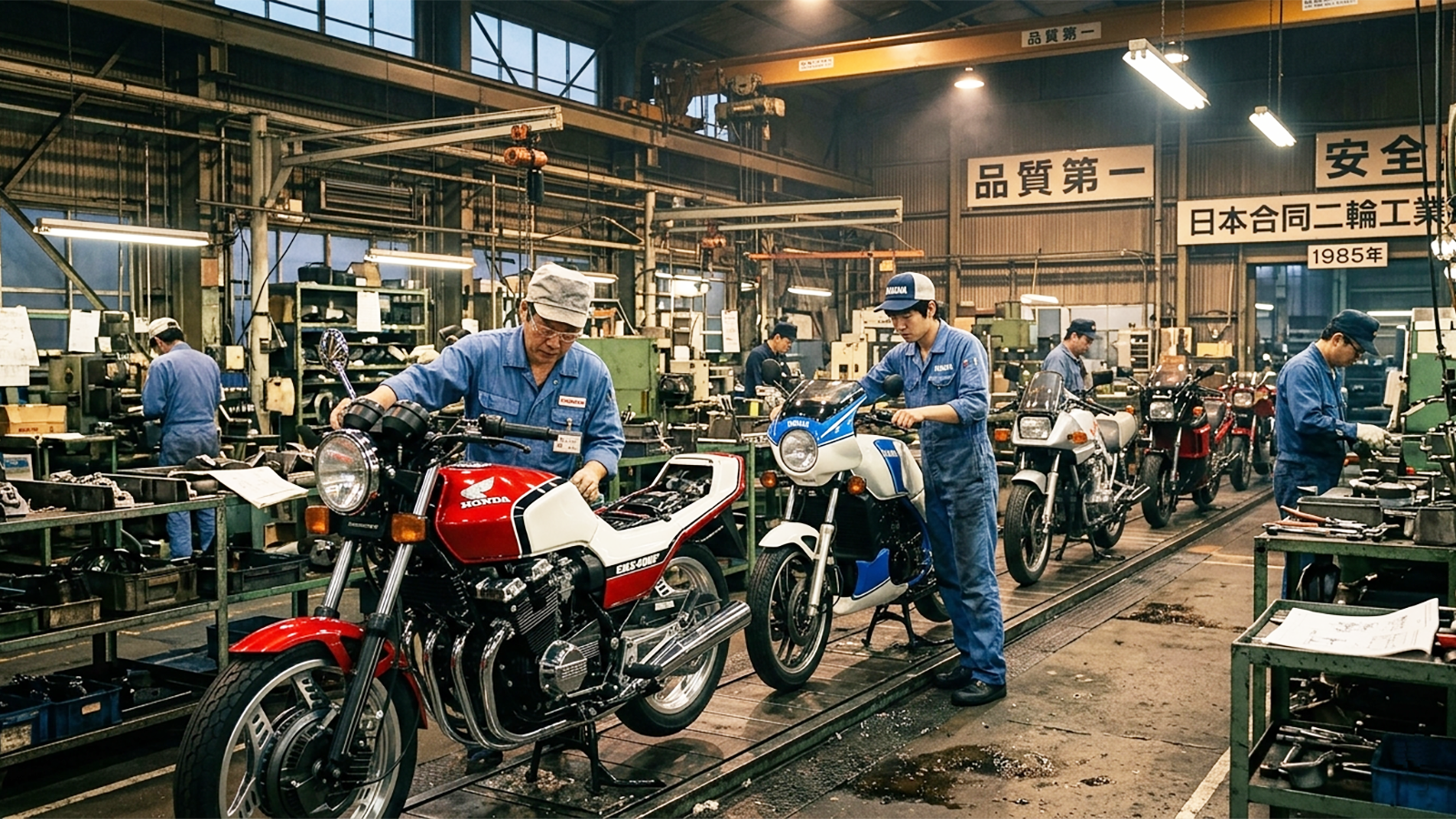
One of the most important reasons for Japan’s success was its manufacturing culture.
Japanese companies focused on:
- Precision
- Reliability
- Continuous improvement
- Long-term quality
This philosophy is known as Kaizen — continuous improvement.
Unlike many Western companies, Japanese manufacturers constantly refined their products.
Small improvements over time created major advantages.
For example:
- Engine durability improvements
- Weight reduction
- Improved aerodynamics
- Better fuel efficiency
These incremental improvements made Japanese motorcycles more reliable and easier to ride.
Riders noticed the difference.
Kaizen and Just-in-Time: Japan’s Manufacturing Advantage
Japanese manufacturing success was also driven by unique production philosophies such as Kaizen and Just-in-Time.
Kaizen focuses on continuous improvement. Instead of large changes, Japanese companies make small improvements every day.
Over time, these small improvements lead to major advancements in quality and performance.
Just-in-Time manufacturing reduces waste and improves efficiency by producing only what is needed, when it is needed.
This approach improved:
- Product quality
- Production efficiency
- Cost control
- Reliability
These manufacturing philosophies helped Japanese companies maintain consistently high standards.
This disciplined approach to manufacturing became one of Japan’s greatest competitive advantages.
Japan’s Hidden Supplier Network
Another key factor was Japan’s supplier network.
Motorcycle manufacturers relied on hundreds of specialized companies.
Examples include:
- Bridgestone (Tires)
- Showa (Suspension)
- Nissin (Brakes)
- NGK (Spark Plugs)
- DID (Chains)
These companies focused on specific components and became world leaders.
This specialization created superior quality.
Unlike other countries, Japan had many suppliers located close to manufacturers.
This allowed faster development and testing.
Examples of Japanese Supplier Excellence
Japan’s motorcycle industry relied on specialized companies that became global leaders in their fields.
Some notable examples include:
- Bridgestone — Motorcycle tires
- NGK — Spark plugs
- Showa — Suspension systems
- Nissin — Brake systems
- DID — Chains
- Denso — Electronics
These companies focused on precision engineering and reliability.
Many of these suppliers also supported the automotive and aerospace industries, further improving their technological expertise.
This level of specialization contributed to Japan’s global leadership in motorcycle engineering.
Electronics: Japan’s Secret Weapon
During the 1980s and 1990s, Japan also dominated electronics.
Companies such as:
- Sony
- Panasonic
- Denso
- Hitachi
These companies contributed technology such as:
- Electronic fuel injection
- Digital instrumentation
- Engine management systems
This gave Japanese motorcycles a major advantage.
Electronics became increasingly important in performance motorcycles.
Japan was already a global leader in electronics, which accelerated innovation.
Precision Manufacturing and Machine Tools
Japan also led the world in precision manufacturing.
Companies such as:
- FANUC
- Mazak
- Okuma
Produced advanced manufacturing equipment.
These machines allowed Japanese manufacturers to produce high-quality components consistently.
Precision machining resulted in:
- Better engines
- Better reliability
- Lower manufacturing defects
This technological advantage helped Japan dominate global markets.
The Power of Domestic Competition
Japan’s domestic market was extremely competitive.
Four major manufacturers competed:
- Honda
- Yamaha
- Suzuki
- Kawasaki
Each company pushed innovation.
Competition resulted in:
- Faster development
- Better performance
- Higher quality
This intense competition accelerated innovation.
The Japanese Supply Chain Advantage
Japan’s geography also played a role.
Many suppliers were located near manufacturers.
For example:
Hamamatsu became a major motorcycle hub:
- Honda
- Yamaha
- Suzuki
This regional clustering improved collaboration.
Ideas moved quickly.
Prototypes were developed faster.
This created rapid innovation cycles.
Japanese Motorcycle Industry Clusters
Another major reason for Japan’s motorcycle dominance was the formation of industrial clusters.
In Japan, many motorcycle companies and suppliers were concentrated in specific regions. This created powerful innovation hubs.
One of the most famous examples is Hamamatsu, located in Shizuoka Prefecture.
Hamamatsu became the birthplace of several major motorcycle manufacturers:
- Honda
- Yamaha
- Suzuki
Within this relatively small region, engineers, suppliers, and manufacturers worked closely together.
This geographical concentration allowed:
- Faster communication
- Rapid prototyping
- Quick improvements
- Strong supplier relationships
Another important region was Suzuka, home to Honda’s racing and development activities.
These clusters created an environment where innovation could happen faster than anywhere else in the world.
This level of industrial concentration is extremely rare globally and played a crucial role in Japan’s motorcycle success.
Why This Could Only Happen in Japan
Japan’s success was unique.
Few countries have:
- Strong manufacturing culture
- Electronics industry
- Supplier network
- Domestic competition
Japan combined all these factors.
This created a powerful ecosystem.
The Legacy of Japanese Engineering
Today, Japanese motorcycles remain respected worldwide.
Even decades later, motorcycles from the 1980s and 1990s remain popular.
Collectors still value these machines.
Riders still trust Japanese reliability.
The legacy continues.
Japan as a Motorcycle Pilgrimage Destination
Today, Japan remains a special destination for motorcycle enthusiasts around the world.
Many riders visit Japan to explore the birthplace of legendary motorcycles and experience Japanese engineering culture firsthand.
Popular locations include:
- Hamamatsu (Honda, Yamaha, Suzuki origins)
- Suzuka Circuit (Honda racing heritage)
- Mount Fuji area (iconic riding destination)
For enthusiasts, visiting Japan is more than tourism — it is a pilgrimage to the heart of motorcycle history.
This connection between engineering, culture, and riding experience makes Japan one of the most unique motorcycle destinations in the world.
Conclusion
Japan’s dominance in motorcycles was not accidental. It was the result of a powerful industrial ecosystem, strong competition, and a unique manufacturing culture.
This combination created some of the best motorcycles in history.
Understanding this ecosystem helps explain why Japanese motorcycles remain so respected today.
RELATED ARTICLES
- Why Japan Makes the Best Motorcycle Gear
- Best Japanese Motorcycle Gear Brands
- Japanese Motorcycle Manufacturing Culture
- Hidden Motorcycle Companies in Japan
- Best Japanese Motorcycle Helmets