Introduction
Suzuki is often the most misunderstood of Japan’s major motorcycle manufacturers.
It does not always chase extremes.
It does not always follow trends.
And yet, it consistently produces motorcycles that feel surprisingly right.
To understand Suzuki, you need to go back to its origins.
Because unlike many companies, Suzuki was not built around speed or performance.
It was built around efficiency.
And that single idea shaped everything that followed.
- The Origins of Suzuki
- From Looms to Engines
- The First Suzuki Motorcycles
- Lightweight Engineering Philosophy
- Racing and Global Expansion
- Suzuki’s Unique Identity
- Hamamatsu: The Birthplace of Suzuki
- A Pilgrimage for Suzuki Riders
- Why Suzuki Still Matters Today
- Why Riders Eventually Come to Hamamatsu
- Conclusion
- RELATED ARTICLES
The Origins of Suzuki
A Company Built on Textile Machines
Suzuki was founded in 1909 by Michio Suzuki in Hamamatsu, Japan.
Originally, the company produced weaving looms for Japan’s textile industry.
These machines required:
- Precision
- Reliability
- Mechanical simplicity
This background had a direct influence on Suzuki’s future engineering approach.
From Looms to Engines
Post-War Transition
After World War II, Japan needed affordable transportation.
Suzuki began developing motorized bicycles as a solution.
Practical Innovation
Instead of focusing on power, Suzuki focused on usability.
Early designs emphasized:
- Lightweight construction
- Fuel efficiency
- Ease of maintenance
This approach made Suzuki accessible to everyday people.
The First Suzuki Motorcycles
Power Free (1952)
Suzuki’s first motorized bicycle was called the “Power Free.”
It allowed riders to switch between:
- Pedal power
- Engine assist
- Full engine drive
This flexibility was revolutionary at the time.
Colleda Series
Suzuki later developed the Colleda motorcycles, marking its transition into full motorcycle production.
These early models established Suzuki’s identity:
Simple, efficient, and reliable.
Lightweight Engineering Philosophy
Why Lightweight Matters
Suzuki became known for its focus on lightweight design.
Lighter motorcycles offer:
- Better handling
- Lower fuel consumption
- Easier control
Real-World Advantage
Instead of building machines for specifications, Suzuki built machines for actual riding conditions.
This made Suzuki especially popular among:
- Daily riders
- Touring riders
- Practical users
Racing and Global Expansion
Entering the Global Stage
Suzuki expanded internationally during the 1960s and 1970s.
It gained attention through racing success, particularly in smaller displacement classes.
Racing Philosophy
Suzuki approached racing differently.
Rather than focusing only on maximum power, Suzuki optimized:
- Weight
- Efficiency
- Balance
This led to strong results, especially in technical racing environments.
Suzuki’s Unique Identity
What Suzuki Feels Like on the Road
Suzuki motorcycles are not always the most powerful or the most advanced on paper.
But once you ride one, something becomes clear.
They feel natural.
The throttle response is predictable.
The weight feels manageable.
The bike responds exactly the way you expect.
This is not accidental.
Suzuki designs motorcycles for real-world riding conditions, not ideal scenarios.
On mountain roads, this becomes especially noticeable.
Tight corners, uneven surfaces, and changing elevation require control more than raw power.
This is where Suzuki stands out.
It does not demand attention.
It simply works—consistently, quietly, and effectively.
The “Underdog” Strength
Suzuki is often seen as the underdog compared to Honda, Yamaha, and Kawasaki.
But this position allows freedom.
Suzuki is known for:
- Unconventional design choices
- High performance at lower cost
- Practical engineering decisions
Real Rider Focus
Suzuki motorcycles often feel designed for riders who actually use their bikes daily.
This creates a different kind of loyalty.
Hamamatsu: The Birthplace of Suzuki
Where Suzuki’s Flagship Motorcycles Are Built Today
Suzuki’s story in Hamamatsu is not just history.
It continues in the present.
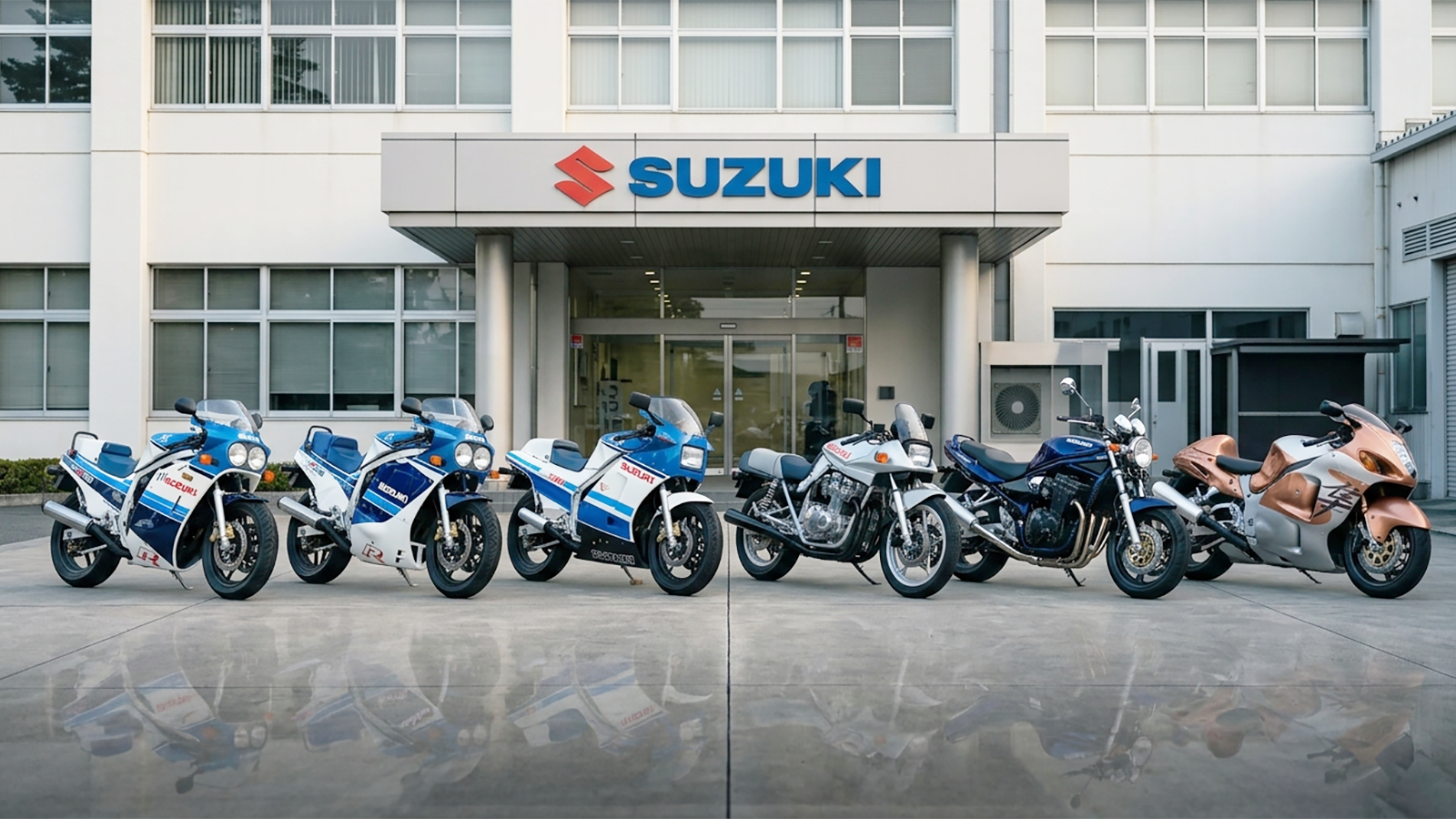
In the Miyakoda area of Hamamatsu, Suzuki operates its main motorcycle production facility, officially known as the Hamamatsu Factory.
This modern plant is relatively new and maintained at a high level of cleanliness and precision.
It is here that many of Suzuki’s flagship large-displacement motorcycles are produced.
This includes globally recognized models such as the Hayabusa, the V-Strom series, and the Katana.
These are not entry-level machines.
They represent Suzuki’s highest level of engineering, performance, and identity.
The environment inside the factory reflects this.
Processes are controlled.
Assembly is precise.
Quality is consistent.
For many riders, motorcycles like the Hayabusa are more than just machines.
They represent speed, engineering ambition, and a unique place in global motorcycle culture.
Knowing that these motorcycles are still built in Hamamatsu changes how you see the city.
This is not just where Suzuki began.
This is where Suzuki continues to define itself.
Watch: Inside Suzuki’s Motorcycle Production
Suzuki’s motorcycles are not just designed—they are carefully built through precise and controlled processes.
This video offers a rare look into how these machines are actually produced in Japan.
From assembly to final inspection, every step reflects Suzuki’s focus on consistency, efficiency, and real-world reliability.
Seeing this process adds a different level of understanding.
These are not just machines.
They are the result of disciplined engineering, built in the same environment you can experience in Hamamatsu.
Suzuki in Everyday Life in Hamamatsu
In Hamamatsu, Suzuki is not a distant brand.
It is part of everyday life.
You will see small displacement bikes used for commuting.
You will see older models still running in perfect condition.
You will see local riders maintaining their machines with care.
This is not a curated experience.
There are no exhibitions or staged environments.
What you see is real.
This is where Suzuki’s philosophy continues—not in marketing, but in daily use.
A Unique Location
Suzuki was born in Hamamatsu, a city that also gave rise to Honda.
Nearby, Yamaha developed in Iwata.
Within a small region of 30–40 kilometers, multiple global motorcycle manufacturers emerged.
This is not normal.
Riding in Hamamatsu Today
When you ride in Hamamatsu, you are not visiting a museum.
You are riding through an active environment.
- Local roads used by real riders
- Coastal routes along Enshu-nada
- Mountain roads in Tenryu
This is where Suzuki’s philosophy still exists in daily life.
A Pilgrimage for Suzuki Riders
For those who understand Suzuki, the connection becomes personal.
It is not about owning the fastest machine.
It is about riding something that feels right.
At some point, that connection creates a question:
“Where did this come from?”
Hamamatsu is not a typical tourist destination.
There are no crowds or staged experiences.
But that is exactly what makes it meaningful.
You ride the same types of roads that shaped Suzuki’s philosophy.
You experience the same balance between practicality and enjoyment.
This is not just travel.
It is a pilgrimage.
Why This Place Changes How You See Suzuki
Before coming to Hamamatsu, Suzuki might feel like just another Japanese brand.
Reliable. Affordable. Practical.
But after riding here, that perception changes.
You begin to understand why the bikes are built the way they are.
You see the roads they were made for.
You feel the environment they were designed in.
And suddenly, the simplicity makes sense.
This is not about lacking something.
It is about removing everything unnecessary.
That realization does not happen through reading.
It happens here.
Why Suzuki Still Matters Today
Practical Innovation
Suzuki continues to focus on real-world usability.
Even modern models reflect:
- Balanced performance
- Accessibility
- Everyday usability
A Different Kind of Value
In a market driven by extremes, Suzuki remains grounded.
This makes it unique.
Not because it is the most powerful.
But because it consistently delivers what riders actually need.
Why Riders Eventually Come to Hamamatsu
At first, Hamamatsu is just a name.
A quiet city in Japan that most people cannot locate on a map.
It is not a famous tourist destination.
It does not appear in typical travel guides.
And yet, for motorcycle riders, it holds a unique significance.
Not immediately, but over time.
Because the more you learn about motorcycles, the more often this place appears.
Honda. Yamaha. Suzuki.
Three of the most influential motorcycle manufacturers in the world all originated within this region.
This is not something that happens by chance.
As you begin to understand this, a simple question naturally emerges:
“Why here?”
The answer is not something you fully understand through reading.
It becomes clear only when you experience the environment yourself.
The roads, the atmosphere, and the everyday presence of motorcycles all reflect the culture that shaped these machines.
Ride through the surrounding areas, and you begin to notice the balance of the roads.
Mountain routes in Tenryu offer flowing curves and quiet isolation.
Coastal roads along Enshu-nada provide long, open stretches shaped by wind and horizon.
These are not designed experiences.
They are real conditions that influenced how Japanese motorcycles were built.
At some point, something changes.
You stop analyzing.
You start feeling.
And that is when Hamamatsu becomes more than a place.
It becomes part of your understanding of motorcycles.
This is why riders come here.
Not for tourism, but for clarity.
And once you realize that, visiting Hamamatsu is no longer just an idea.
It becomes something you feel you need to do.
Conclusion
Suzuki’s history is not defined by dominance or spectacle.
It is defined by consistency.
From textile machines to motorcycles, Suzuki has always focused on efficiency, balance, and real-world performance.
And that is exactly why it still matters.
Because in the end, the best motorcycle is not the one that looks the strongest.
It is the one that fits your life.
To understand how Suzuki fits into the broader story of Japanese motorcycles, explore our full guide:
Japanese Motorcycle Culture Guide.