- Introduction
- The Birth of Honda in Hamamatsu (1946)
- The Golden Era of Honda Hamamatsu (1980–1999)
- Honda’s Early Motorcycle Production
- Why These Honda Motorcycles Became Popular in Europe and North America
- Growth of Honda in Hamamatsu
- Expansion into Marine Engines (1964)
- Honda Motorcycle Production Transfer (2008)
- Honda Hamamatsu Today
- Visiting Honda History in Hamamatsu
- Honda Hamamatsu Beyond Motorcycles: Marine and Transmission Facilities
- Why Hamamatsu Matters in Motorcycle History
- Conclusion
- RELATED ARTICLES
Introduction
Hamamatsu, a coastal city in Shizuoka Prefecture, holds a special place in global motorcycle history. This city is where Honda Motor Company began its journey and where the first Honda motorcycles were created.
Today, Honda is the world’s largest motorcycle manufacturer. But the company started in a small workshop in Hamamatsu in 1946. From this modest beginning, Honda grew into a global engineering powerhouse.
This article explores the history of Honda in Hamamatsu, from its humble origins to its modern manufacturing role. We’ll also look at the city’s continued importance in Honda’s global operations.
This article also supports our main pillar guide:
The Complete History of Japanese Motorcycles
Why Honda Hamamatsu Factory Became Legendary
The Honda Hamamatsu Factory was more than just a production facility. It became one of the most important motorcycle manufacturing centers in the world.
From the 1980s to the late 1990s, many of Honda’s most influential motorcycles were developed and produced here. These bikes helped Honda dominate European and North American markets.
Engineers at Hamamatsu focused on:
- Lightweight design
- High-performance engines
- Rider-focused ergonomics
- Racing-inspired technology
These design philosophies shaped Honda’s global reputation. Many riders still consider motorcycles from this era to be among the best ever built.
Today, the Hamamatsu Factory remains a symbol of Honda’s engineering excellence and innovation.
The Birth of Honda in Hamamatsu (1946)
In 1946, Soichiro Honda founded the Honda Technical Research Institute in Yamashita-cho, Hamamatsu City.
Japan was recovering from World War II. Transportation was limited, and people needed affordable mobility. Honda saw an opportunity to provide simple motorized bicycles.
Using surplus military engines, Honda began attaching small engines to bicycles. These early machines became extremely popular.
The first Honda motorized bicycles helped people:
- Commute to work
- Transport goods
- Travel longer distances
Demand grew quickly, and Honda began producing engines in larger quantities.
This small workshop in Hamamatsu marked the beginning of one of the world’s most influential motorcycle companies.
The Golden Era of Honda Hamamatsu (1980–1999)
The period between 1980 and 1999 is widely considered the golden era of Honda motorcycles produced at the Hamamatsu Factory. During this time, Honda introduced a series of groundbreaking motorcycles that became extremely popular in Europe and North America.
These motorcycles combined performance, reliability, and innovative engineering. Many of them went on to define entire categories of sport and touring motorcycles.
Some of the most iconic motorcycles produced during this era include:
- Honda VFR750F — Known for its V4 engine, durability, and balance between sport and touring
- Honda CBR600F — A lightweight, versatile sport bike that became extremely popular in Europe
- Honda CBR900RR Fireblade — A revolutionary superbike that redefined lightweight performance
- Honda VTR1000F Firestorm — A powerful V-twin sport bike designed to compete with European rivals
- Honda CBR1100XX Blackbird — One of the fastest motorcycles in the world and a legendary sport-touring machine
These motorcycles helped establish Honda’s global reputation for engineering excellence and rider-focused design.
During this period, Honda engineers in Hamamatsu focused on several key innovations:
- Lightweight chassis development
- High-performance engines
- Aerodynamic design
- Long-distance comfort
- Racing-inspired technology
These innovations allowed Honda motorcycles to compete directly with European manufacturers such as Ducati, BMW, and Triumph — and often surpass them in reliability and everyday usability.
Today, many riders and collectors consider motorcycles from this era to be among the best Honda ever produced. The Hamamatsu Factory played a crucial role in shaping Honda’s identity as a global leader in performance motorcycles.
Watch the Golden Era Honda Motorcycles
To better understand why Honda motorcycles from the Hamamatsu Factory became so popular in Europe and North America, watch the video below featuring some of the most iconic machines from the 1980s and 1990s.
These motorcycles represent Honda’s engineering excellence, lightweight performance philosophy, and global influence during the golden era.
Featured motorcycles include:
- Honda VFR750F
- Honda CBR600F
- Honda CBR900RR Fireblade
- Honda VTR1000F Firestorm
- Honda CBR1100XX Blackbird
These legendary motorcycles helped establish Honda as a global leader in performance motorcycles.
Honda’s Early Motorcycle Production
In 1949, Honda released its first full motorcycle — the Honda Dream D-Type.
This motorcycle represented a major step forward. Unlike motorized bicycles, the Dream D-Type was designed as a complete motorcycle.
Key features included:
- 98cc two-stroke engine
- Steel frame
- Improved suspension
The Dream D-Type quickly gained popularity across Japan.
Production expanded in Hamamatsu, and Honda began hiring more workers.
By the early 1950s, Honda introduced additional models including:
- Honda Cub F engine
- Honda Dream E-Type
- Honda Benly series
These motorcycles helped Honda establish its reputation for reliability and affordability.
Why These Honda Motorcycles Became Popular in Europe and North America
Honda motorcycles produced in Hamamatsu gained massive popularity overseas for several key reasons.
Reliability
European riders quickly noticed that Honda motorcycles required less maintenance compared to many European brands.
Performance
Honda introduced lightweight frames and high-performance engines that appealed to sport riders.
Affordability
Compared to European motorcycles, Honda bikes often offered better performance at a lower price.
Comfort
Many Honda sport bikes were also comfortable for long-distance riding, making them popular for touring.
These qualities helped Honda gain a loyal global following.
Growth of Honda in Hamamatsu
During the 1950s and 1960s, Honda experienced rapid growth. The Hamamatsu factory became a major production center.
Honda’s engineering culture developed in Hamamatsu:
- Continuous improvement
- Quality manufacturing
- Innovation
These principles later became global standards.
One of Honda’s most important developments during this period was the expansion of exports.
Honda began exporting motorcycles to:
- United States
- Europe
- Southeast Asia
The success of Honda motorcycles worldwide began in Hamamatsu.
Expansion into Marine Engines (1964)
In 1964, Honda expanded into marine engine production in Hosoe, Hamamatsu.
This marked the beginning of Honda’s marine business.
The marine division focused on:
- Outboard motors
- Marine engines
- Boat propulsion systems
Hamamatsu became an important hub for Honda’s marine technology.
The marine business grew steadily and continues today.
This diversification demonstrated Honda’s engineering capabilities beyond motorcycles.
Honda Motorcycle Production Transfer (2008)
In 2008, Honda transferred motorcycle production from Hamamatsu to the Kumamoto Factory.
This marked the end of large-scale motorcycle production in Hamamatsu.
Reasons for the transfer included:
- Production efficiency
- Facility modernization
- Global manufacturing strategy
The Kumamoto Factory became Honda’s main motorcycle production facility in Japan.
Although motorcycle production ended, Hamamatsu remained an important engineering center.
Honda Hamamatsu Today
Today, the Hamamatsu facility operates as the Honda Transmission Manufacturing Plant.
This factory focuses on:
- Transmission systems
- Powertrain components
- Engineering development
Hamamatsu continues to play a key role in Honda’s global manufacturing network.
Honda’s legacy remains deeply connected to the city.
Visiting Honda History in Hamamatsu
Motorcycle enthusiasts visiting Hamamatsu can explore Honda’s origins.
Nearby attractions include:
- Honda birthplace location
- Hamamatsu industrial heritage sites
- Shizuoka coastal riding routes
Hamamatsu is also close to:
- Mount Fuji
- Izu Peninsula
- Lake Hamana
These destinations make Hamamatsu an excellent stop for motorcycle touring.
Honda Hamamatsu Beyond Motorcycles: Marine and Transmission Facilities
While the Hamamatsu Factory is widely known as the birthplace of Honda motorcycles, the region remains an important manufacturing hub for Honda today. Two major facilities continue Honda’s engineering legacy in the Hamamatsu area.
These include:
- Honda Marine Outboard Engine Factory (Hosoe, Hamamatsu)
- Honda Transmission Manufacturing Plant (Hamamatsu)
These facilities represent Honda’s continued innovation and engineering excellence.
For motorcycle enthusiasts, visiting these locations becomes more than just sightseeing — it becomes a meaningful pilgrimage to Honda’s engineering roots.
Honda Marine Business in Hosoe (1964–Present)
In 1964, Honda began its marine business in Hosoe, located in northern Hamamatsu near Lake Hamana.
This marked Honda’s entry into the marine industry and expanded the company’s engineering expertise beyond motorcycles and automobiles.
The Hosoe facility focuses on:
- Outboard engines
- Marine propulsion systems
- Small boat engines
Lake Hamana, located near the factory, provided an ideal testing environment for marine engines. The calm waters and coastal access allowed Honda engineers to refine performance and reliability.
Today, Honda Marine products are used worldwide, from fishing boats in Southeast Asia to recreational boats in North America and Europe.
For visitors, the Hosoe area offers scenic riding routes around Lake Hamana. Many motorcycle riders include this location as part of a Honda heritage tour.
This makes Hosoe not just a factory location, but an important chapter in Honda’s engineering story.
Honda Transmission Manufacturing Plant — Birthplace of Legendary Motorcycles
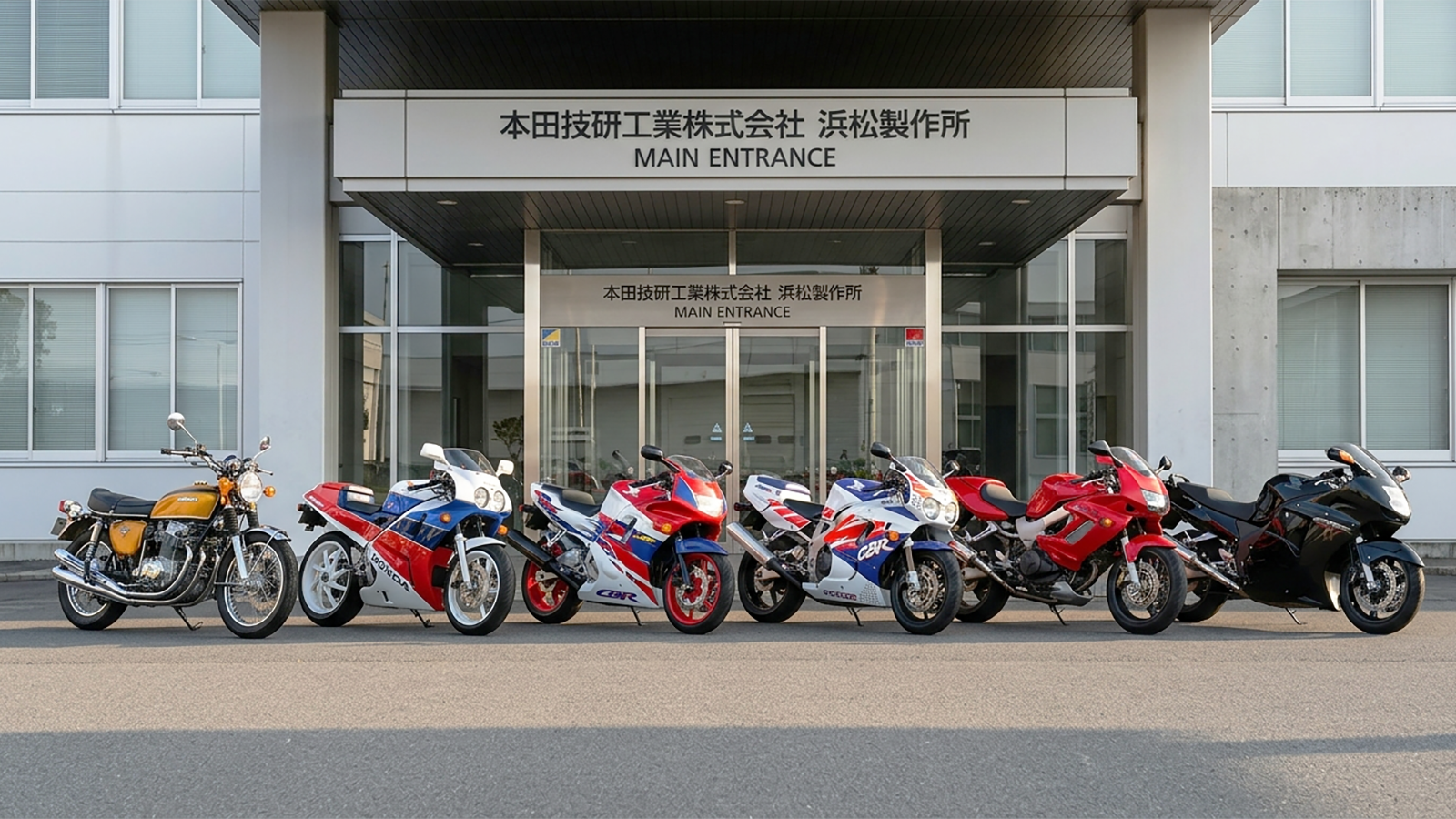
Today, the former Hamamatsu motorcycle factory operates as Honda’s transmission manufacturing plant.
Although motorcycle production ended in 2008, this facility remains one of the most historically important locations for Honda enthusiasts.
This site was once the birthplace of many legendary Honda motorcycles, including:
- VFR750F
- CBR600F
- CBR900RR Fireblade
- VTR1000F Firestorm
- CBR1100XX Blackbird
These motorcycles were developed and produced here before being exported worldwide.
For many riders, visiting this location is considered a “homecoming journey” — a chance to visit the birthplace of their motorcycles.
This creates a unique emotional connection between rider and machine.
Standing in front of the Hamamatsu facility, riders often realize:
Their motorcycle was born here.
Engineered here.
Tested here.
Then shipped across the world.
This makes the Hamamatsu Transmission Plant one of the most meaningful destinations for Honda enthusiasts.
A Motorcycle Pilgrimage: The Honda Hamamatsu Heritage Tour
For Honda riders, Hamamatsu offers a unique motorcycle pilgrimage experience.
A recommended Honda heritage route includes:
- Honda Hamamatsu Transmission Plant
- Honda Marine Hosoe Facility
- Lake Hamana Scenic Roads
- Hamamatsu City Honda Birthplace Area
This route combines:
- Motorcycle history
- Scenic riding
- Cultural exploration
The coastal roads around Lake Hamana provide relaxed touring opportunities. Riders can also enjoy local specialties such as Hamamatsu gyoza and eel dishes.
This makes Hamamatsu not only historically important but also an excellent motorcycle touring destination.
Why Hamamatsu Matters in Motorcycle History
Hamamatsu is also home to other major manufacturers:
- Yamaha Motor
- Suzuki Motor
This region became Japan’s motorcycle capital.
The concentration of engineering talent helped shape the global motorcycle industry.
Conclusion
Honda’s journey began in a small workshop in Hamamatsu in 1946. Today, Honda is a global leader in motorcycles, automobiles, and marine engines.
Although motorcycle production moved to Kumamoto in 2008, Hamamatsu remains the birthplace of Honda innovation.
For motorcycle enthusiasts, Hamamatsu represents one of the most important locations in motorcycle history.
RELATED ARTICLES
- Why Japanese Motorcycles Are Famous
- The Complete History of Japanese Motorcycles
- Motorcycle Pilgrimage Hamamatsu
- History of Yamaha Motorcycle
- History of Suzuki Motorcycles
- History of Kawasaki Motorcycles
- Best Motorcycle Roads in Shizuoka
- Japanese Manufacturing Culture